
In regulated industries, identity verification is often treated as a fixed obligation.
Every user goes through the same process. Every business submits the same documents. Every onboarding flow looks identical.
While this approach feels safe, it is rarely efficient.
Applying uniform verification standards to all customers increases friction, slows onboarding, inflates compliance costs, and strains internal teams. At scale, this model becomes unsustainable.
The more mature approach is not stricter verification. It is smarter verification.
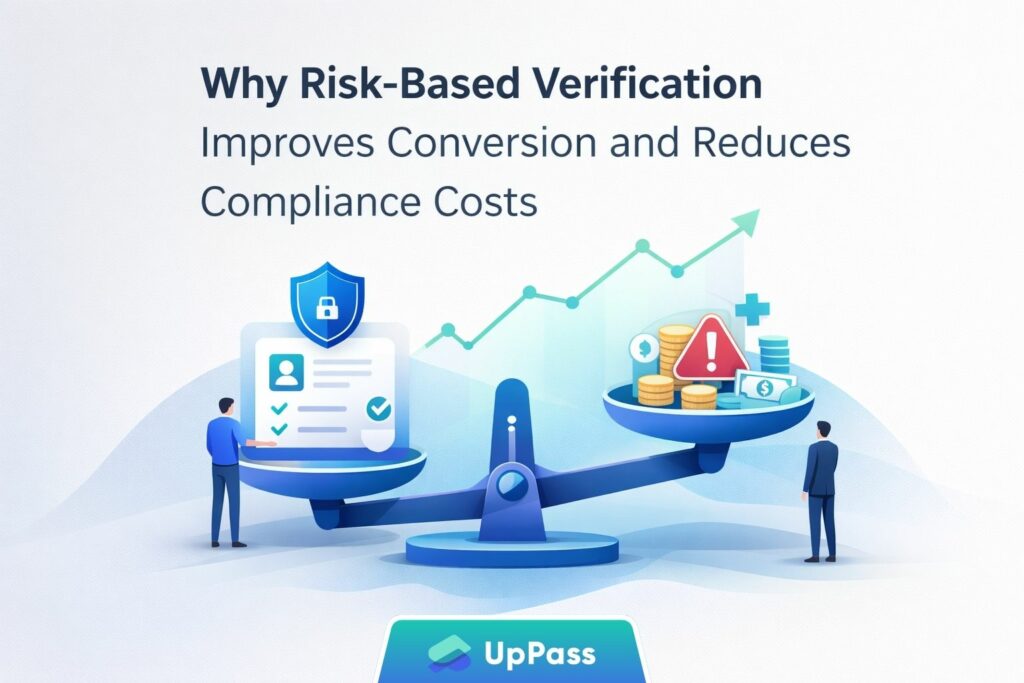
This is where risk-based verification changes the equation.
UpPass enables organizations to implement dynamic verification workflows that adapt to actual risk levels, helping businesses improve conversion rates while maintaining regulatory confidence and operational control.
In this article, we explore what risk-based verification truly means, why it aligns with global regulatory expectations, and how it drives measurable improvements in both growth and compliance efficiency.
The Problem With One-Size-Fits-All Verification
Uniform verification processes are easy to design but costly to operate.
When every customer must complete the same comprehensive verification flow, businesses often experience:
• Higher onboarding drop-off rates
• Increased document resubmissions
• Longer processing times
• Greater manual review workload
• Elevated compliance costs
At the same time, applying excessive checks to low-risk customers does not meaningfully improve risk control. It simply reallocates resources away from higher-risk cases that require deeper scrutiny.
Regulators do not expect identical treatment for all customers. In fact, global AML and KYC frameworks encourage the opposite.
They expect proportionality.
What Is Risk-Based Verification?
Risk-based verification is an approach where the depth and intensity of identity checks are determined by the assessed risk of the customer or business.
Rather than applying a fixed process, verification requirements are calibrated based on factors such as:
• Customer type
• Geographic exposure
• Industry sector
• Transaction behavior
• Ownership structure
• Regulatory risk profile
In practical terms:
Low-risk users may complete a simplified verification flow.
Medium-risk users may require additional document or biometric validation.
High-risk users may trigger enhanced due diligence, ownership analysis, or manual review.
This methodology aligns directly with international compliance standards that emphasize risk-based customer due diligence.
The goal is not less compliance. It is better allocation of compliance effort.
Why Risk-Based Verification Improves Conversion
Onboarding friction is one of the most underestimated growth constraints in regulated businesses.
Each additional verification step introduces a potential drop-off point. Long forms, repeated uploads, and unclear requirements create hesitation and abandonment.
Risk-based verification improves conversion by reducing unnecessary complexity for legitimate, low-risk users.
When onboarding flows are aligned with actual risk:
• Verification becomes faster
• Fewer documents are required for low-risk profiles
• Approval times decrease
• User confidence increases
This creates a smoother onboarding journey without compromising security.
The impact is measurable. Even small improvements in completion rates can significantly increase lifetime customer value at scale.
Reducing Compliance and Operational Costs
From a compliance standpoint, uniform verification often leads to inefficient resource allocation.
Manual review teams become overloaded with low-risk cases. Alert volumes increase. False positives consume time and attention.
Risk-based verification helps organizations:
• Prioritize high-risk customers for enhanced scrutiny
• Reduce manual intervention for straightforward cases
• Minimize unnecessary enhanced due diligence
• Improve investigation turnaround times
• Lower total onboarding cost per customer
By automating decision pathways based on risk signals, compliance teams can focus on cases that genuinely require expertise and oversight.
This reduces operational strain while strengthening overall risk management.
Regulatory Alignment and Strategic Resilience
Risk-based verification is not simply a growth optimization strategy. It is also a regulatory expectation.
Global AML and KYC frameworks emphasize proportionality and ongoing risk assessment. Regulators increasingly expect institutions to demonstrate that their customer due diligence processes are tailored and adaptive.
A static verification model can become a compliance liability in evolving regulatory environments.
Dynamic, risk-driven workflows provide greater resilience. They allow businesses to:
• Adjust verification thresholds when regulatory guidance changes
• Respond to emerging risk patterns
• Apply enhanced scrutiny where exposure increases
• Maintain defensible compliance documentation
Adaptability is critical for organizations expanding across jurisdictions with differing regulatory standards.
How UpPass Enables Risk-Based Verification
Effective risk-based verification requires flexible infrastructure.
UpPass supports dynamic verification design across both eKYC and eKYB use cases by enabling organizations to:
• Define configurable risk criteria based on data signals
• Automatically adjust verification steps according to risk level
• Route higher-risk profiles to enhanced due diligence workflows
• Apply consistent standards across multiple markets
Workflows can be updated as business models evolve or regulatory requirements change, without requiring full system redevelopment.
This flexibility ensures that compliance processes remain aligned with actual risk exposure rather than becoming rigid operational bottlenecks.
Risk Does Not End at Onboarding
Customer risk profiles are not static.
Ownership structures change. Transaction behavior evolves. External risk indicators shift over time.
A truly effective risk-based verification strategy extends beyond initial onboarding and supports ongoing reassessment.
UpPass enables continuous risk evaluation by:
• Re-triggering verification when risk thresholds are exceeded
• Supporting additional checks when new data signals emerge
• Integrating onboarding and ongoing monitoring logic
This lifecycle approach ensures that verification remains proportionate and responsive.
The Business Impact of Smarter Verification
When risk-based verification is implemented effectively, the benefits extend across the organization:
Improved conversion rates through reduced friction
Lower compliance costs through targeted resource allocation
Stronger fraud prevention by focusing on high-risk cases
Greater regulatory defensibility through proportional controls
Scalable infrastructure that supports geographic expansion
In competitive digital markets, efficiency and compliance must coexist. Risk-based verification enables both.
Conclusion: Proportional Verification as a Growth Strategy
Compliance does not require complexity for its own sake.
It requires precision.
Risk-based verification allows regulated businesses to apply the right level of scrutiny to the right customers at the right time. It reduces unnecessary friction, lowers operational costs, and strengthens regulatory alignment.
UpPass enables organizations to operationalize this strategy through configurable, adaptive verification workflows that scale with growth.
In a landscape where both regulators and customers demand accountability, smarter verification is not optional.
It is essential for sustainable expansion.
Automate your end-to-end eKYB process without writing code now. www.uppass.io/ekyb
Looking for customized solutions and discuss with experts? https://meetings.hubspot.com/phuwarat
Other Business Verification Blog Posts