
Most financial businesses have become good at KYC. A new customer can scan an ID, take a selfie, pass a liveness check and be approved without speaking to anyone. For individuals, digital onboarding is largely a solved problem.
Then a business customer applies, and everything slows down again. The request for a company certificate goes out by email. Then a shareholder list, then director IDs, then a corrected version of something sent last week. What took minutes for a person can take weeks for a company.
That gap exists because KYB isn’t simply KYC applied to a company. Verifying a business is a different problem, and it needs a different playbook.
Why verifying a business is harder
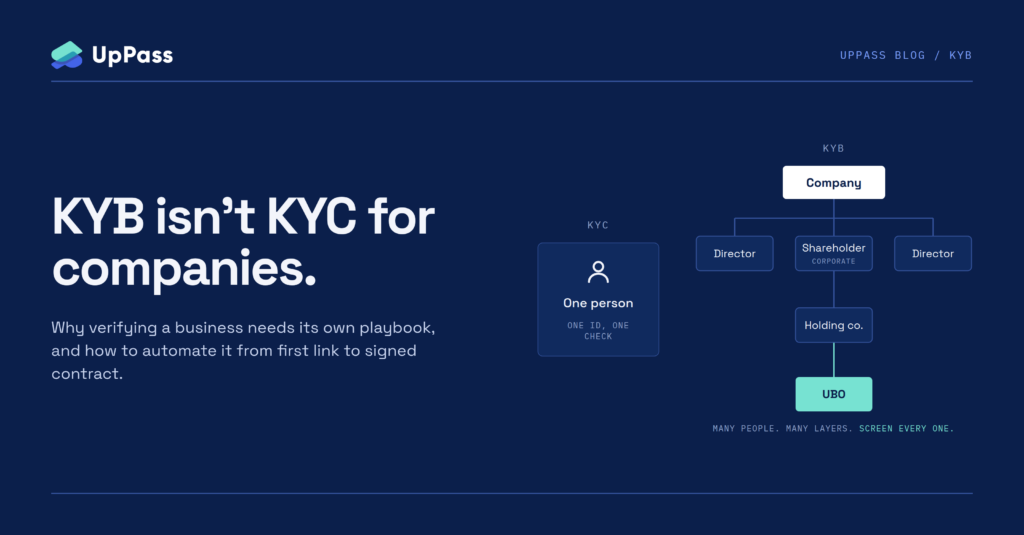
A company is never just one party. When you verify an individual, you check one person against one identity. When you verify a business, you’re verifying a legal entity, plus the people who act for it, own it, and ultimately control it. Every director and significant shareholder is a person you may need to identify and screen.
Ownership can hide behind layers. A shareholder may itself be a company, owned by a holding company, owned by a trust. Each layer is legitimate on its own, but together they can obscure the ultimate beneficial owner, the person regulators most want you to find.
The data is fragmented. Company information sits in registries that differ by country in format, language, and level of detail. Pulling it together by hand means stitching records that were never designed to be read together.
Authority matters as much as identity. It’s not enough to know who the directors are. You also need to know that the person signing the contract is actually authorised to act for the company.
The job doesn’t end at onboarding. Directors change, shares get transferred, and new names appear on sanctions lists. A company that was low-risk at onboarding may not stay that way.
What manual KYB really costs
When all of this runs through email and spreadsheets, the costs build up quietly. Turnaround stretches from days into weeks, and good customers walk away before they’re approved. Analysts spend their time chasing documents instead of assessing risk. Two reviewers can reach different conclusions on similar cases. And when an auditor asks how a decision was made, the answer is buried somewhere in an inbox.
The five building blocks of a better KYB process
1. Verify the entity at the source. Confirm the company’s existence and details directly against local registries and trusted data sources, rather than relying only on documents the customer uploads.
2. Map the people and the ownership. Identify directors and shareholders, and follow ownership through each corporate layer until you reach the ultimate beneficial owners.
3. Confirm authority and identity together. Check that the person applying or signing is a verified director with the authority to act, and confirm their identity with eKYC in the same flow.
4. Screen everyone, and keep screening. Run AML, PEP, and adverse media checks across the company, its directors, its shareholders, and its UBOs. Then monitor them continuously, so changes surface when they happen.
5. Close the loop to the contract. Once a business is verified, move its details straight into your agreement and e-signature process, so the person who signs is the person you verified.
How UpPass approaches it
UpPass was built to bring these building blocks together in one place. Instead of an email thread, your business customer receives one secure onboarding link. Behind that link, UpPass verifies the company through local registry connections, identifies directors and UBOs, confirms signer authority with integrated eKYC, runs AML, PEP, and adverse media screening across every related party, and passes verified details into your e-signature flow.
Your compliance and operations teams build these workflows themselves with a no-code builder, and they set decision rules that match their own risk policies. When regulations or internal requirements change, they update the flow without waiting on an engineering sprint.
The takeaway
KYC taught the industry that digital onboarding can be fast and safe at the same time. KYB can get there too, but only if it’s treated as its own discipline: one that accounts for many people, layered ownership, fragmented data, and ongoing risk.
If your business onboarding still lives in an inbox, it’s worth seeing what it looks like when it doesn’t. Book a demo with UpPass
UpPass enables businesses to build this foundation by combining identity verification, fraud detection, and compliance into a unified, scalable system.
Because in the digital economy, trust is not assumed.
It is built, verified, and protected at every step.
Automate your eKYB process without writing code now. www.uppass.io/ekyb
Other eKYB Blog Posts :